
Key summary. Juvelook is a Korean-developed ingredient that stimulates collagen production in the skin. It also contains hyaluronic acid (HA), which adds hydration, and it is registered as a medical device with the Ministry of Food and Drug Safety (MFDS). A 33-participant clinical trial compared it with Sculptra, its main competing ingredient. After 6 months, the two products improved nasolabial folds to a similar degree — meaning Juvelook was not inferior to Sculptra. The manufacturer funded this study. Physicians reported a "faster sense of volume" with Juvelook, but the measured scores did not confirm it.
What this article covers
- How Juvelook and Sculptra differ in ingredients and particle shape
- What effects and side effects the 33-participant clinical trial actually found
- What else to consider when reading this study (who funded it, and safety issues such as pain and swelling)
Key points
- Who it applies to: The study enrolled adults who wanted to improve areas with moderate sagging and volume loss, such as nasolabial folds.
- Order of checks: exact product name and Korean approval status → what the study's conclusion means → who funded the study → practitioner qualifications.
01 How do the ingredients in Juvelook and Sculptra differ?
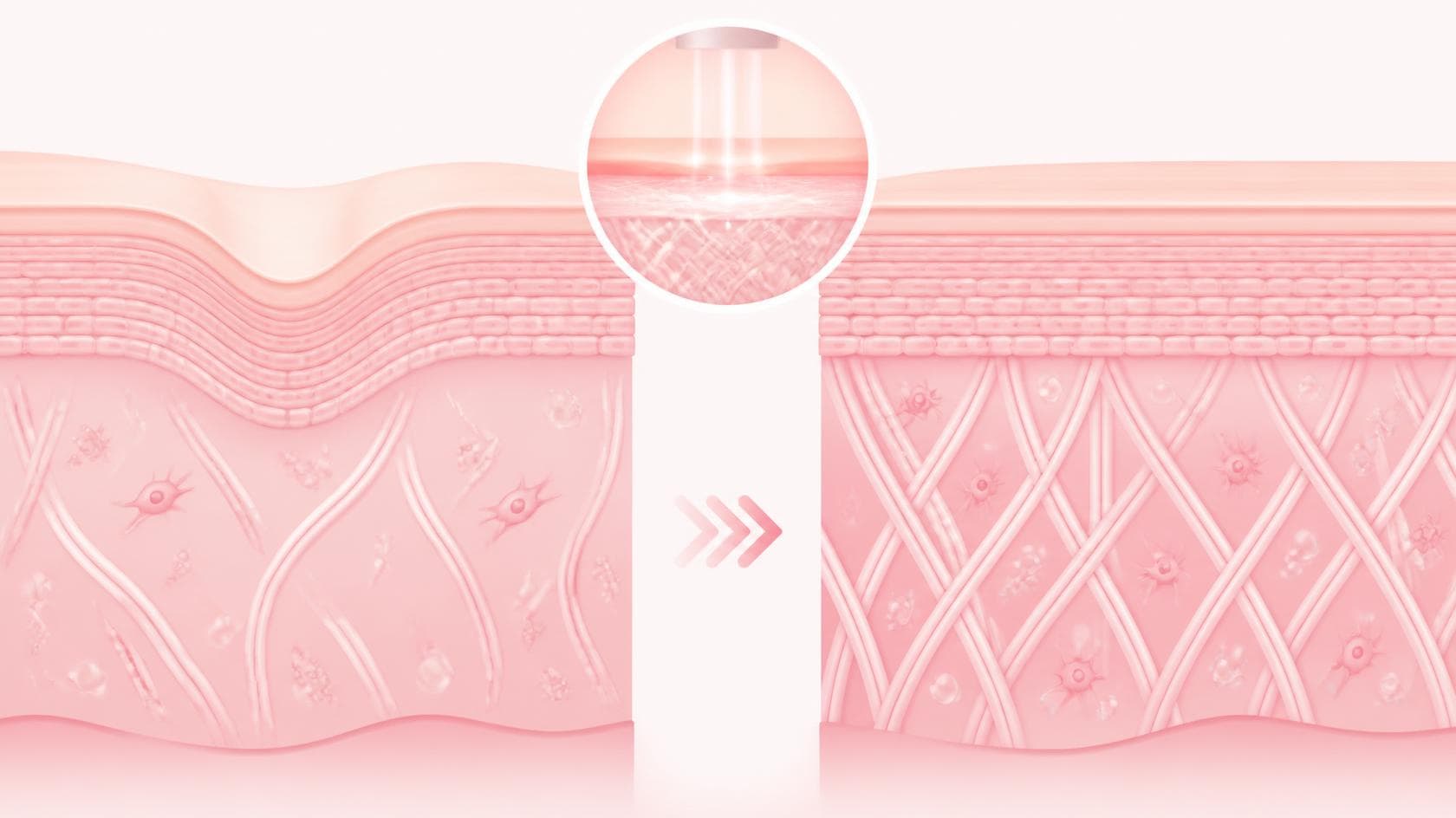
Juvelook and Sculptra both break down slowly in the skin and stimulate collagen production. They are chemically related, but their particles have different shapes. Sculptra has sharp, dense particles. Juvelook has porous, sponge-like particles, so the body absorbs it faster. Juvelook also contains hyaluronic acid (HA), which adds hydration and some volume right after injection.
MFDS registration records list several names, including Juvelook, Juvelook Volume, and Juvelook Skin, under the same permit number (Manufacturing permit 17-972, Vaim Co., Ltd.). These are several models sold under different names. During your consultation, confirm the exact model name and check that it fits your goal (restoring volume or improving skin texture). Class 4 is the highest-risk category for medical devices in Korea. Devices in this class go through a relatively strict review before approval and remain under ongoing safety monitoring after they reach the market.
02 How much do Juvelook and Sculptra differ in effect?
| Item | Juvelook Volume (PDLLA+HA) | Sculptra (PLLA, comparator) |
|---|---|---|
| Participants | 33 people (24 women) with moderate or more severe nasolabial folds; each person was treated with one product on each side of the face | Opposite side of the same participants |
| Treatment | 3 injections at 4-week intervals | Same |
| Change in wrinkle score after 6 months | Decreased from 3.42 points to 2.05 points (wrinkles became shallower) | Decreased from 3.36 points to 2.16 points |
| Comparison of the two products | Not inferior to Sculptra at any time point | — |
| Overall improvement (clinician assessment) | No clear difference between the two products | No clear difference between the two products |
| Patient satisfaction (20 respondents) | 80% were "very satisfied" or "satisfied"; 15% preferred Juvelook | 15% preferred Sculptra; 70% noticed no difference |
| Side effects | Mostly mild swelling that went down within 3–4 days; 1 person had more severe swelling and pain after the second injection, which improved with medication | Mostly mild swelling |
A lower wrinkle score means the wrinkles became shallower. Both products improved results by a similar amount, and the statistical conclusion is that "Juvelook is not worse than Sculptra." This means "about the same," not "better". The study compared the two sides of each person's face. This design lowers the chance that individual differences, such as age or skin type, affected the results.
The 4 participating physicians said Juvelook seemed to add volume faster right after injection, but the actual scores did not show this difference. In other words, how results feel and what is measured can differ.
03 What to check before the procedure
| Item to check | Why it matters | How to check |
|---|---|---|
| Exact product name (model) | Several products are sold under the Juvelook name, so you need to know exactly which one you are receiving to judge whether it suits your goal | Ask directly for the model name during the consultation (for example, whether it is Juvelook Volume or Juvelook Skin) |
| Nature of the evidence | "Similar" and "better" mean different things | Check which of the two the explanation you are given actually claims |
| Source of research funding | You should know when a study was paid for by the company before you read it | Check whether the evidence materials state the source of research funding |
| Practitioner qualifications | Whether the practitioner is a board-certified specialist and how much experience they have with this procedure | Clinic information and HIRA (Health Insurance Review and Assessment Service) public data |
| Side effect information | Most side effects are mild, but there were cases of significant swelling and pain | Ask in advance how side effects will be handled if they occur |
04 Choosing by situation
- If you want to improve areas that have lost volume, such as nasolabial folds → confirm during the consultation whether the model covered by the study reviewed here (Juvelook Volume) is the right fit
- If your goal is improving skin texture or elasticity → other models such as Juvelook Skin were not the subject of this study, so ask for separate evidence
- If you are deciding between this and Sculptra → this study provides evidence that Juvelook is "similar," not that it is "better," so compare using other criteria such as pain, recovery time, and cost
05 Common misconceptions
"An immediate effect has been clinically proven" — This only means the physicians perceived it that way; when the results were actually measured, no difference appeared.
"It is a new product that is always better than fillers" — As shown above, what this study demonstrated is "similar," not "better."
"This study is a fully independent third-party verification" — The company that makes Juvelook funded the research. This is worth knowing, separately from the physicians' statement that they had no conflicts of interest.
06 In summary
Juvelook is a Korean-developed ingredient that is chemically a close relative of Sculptra but has differently shaped particles. The study and the misconceptions reviewed above show what has and has not been confirmed about this ingredient. However, this study followed patients for only 6 months, and there is not yet any data confirming differences in effect over the longer term. When you have a consultation, it is a good idea to ask for both the exact model name and the evidence for that specific model. Rejuran, which uses a similar ingredient (PDRN), has a different evidence structure, so you can compare the two.
07 Frequently Asked Questions
How is Juvelook different from Sculptra?
Their ingredient compositions are different. This is covered in detail in item 1 above.
Is Juvelook more effective than Sculptra?
No. Contrary to the expectation that "a new product must be better," this study showed only that the two are at a similar level. You should also keep in mind that follow-up lasted only 6 months. For detailed figures, see the table in item 2 above.
Is Juvelook approved in Korea?
Yes. Several models, including Juvelook and Juvelook Volume, are registered as medical devices with the Ministry of Food and Drug Safety (MFDS) (Manufacturing permit 17-972). However, intended uses can differ by model, so it is a good idea to confirm the exact product name separately during the consultation.
Is the Juvelook research reliable?
The study design itself is reasonably sound — it compared the two sides of the same person's face, and the evaluating physicians did not know which side received Juvelook. However, you should keep in mind that the manufacturer funded the research. Whether a study was well designed and who paid for it are separate questions.
08 Pre-consultation checklist
- □ I confirmed the exact product name (model) to be used in my procedure
- □ I confirmed its approval status in Korea (
Manufacturing permit 17-972) - □ I confirmed whether the evidence presented to me shows "non-inferiority" or "superiority"
- □ I confirmed the funding source of that research (whether it was supported by the manufacturer)
- □ I confirmed which medical staff will actually perform the procedure and their qualifications
- □ I was informed about side effects (swelling, tenderness, etc.) and how they will be handled
09 Glossary
- RCT (randomized controlled trial): A study design that assigns participants to groups at random and compares them. It is considered a relatively reliable type of research.
- Controlled study: A study that includes a separate comparison group (control group) alongside the group that received the procedure. Without a control group, it is hard to tell whether an improvement came from the procedure or from some other cause.
- p-value: A number showing how likely it is that the difference between two groups arose purely by chance. Generally, if it is below 0.05, the difference is considered "unlikely to be due to chance (statistically significant)."
- Non-inferiority trial: A study design that checks whether a new treatment is not worse than an existing treatment by more than a predefined acceptable margin. It aims to show that the new treatment is "not worse," not that it is "better."
- WSRS (Wrinkle Severity Rating Scale): An assessment tool that clinicians use to score the depth of wrinkles, such as nasolabial folds, against set criteria. A lower score means shallower wrinkles.
- GAIS (Global Aesthetic Improvement Scale): A scale on which clinicians or participants grade how much the appearance has improved compared with before the procedure.
- Split-face trial: A study design that applies a different product or procedure to the left and right sides of the same person's face and compares the results. This can reduce the influence of differences between individual participants.
10 Sources and verification date
- PMC12802405 — verified 2026-09-19. Multicenter split-face RCT, 33 participants, 24-week follow-up, research funding from the manufacturer (Vaim Co., Ltd.), authors declared no conflicts of interest.
- Ministry of Food and Drug Safety (MFDS) medical device UDI search — Juvelook product line
Manufacturing permit 17-972, verified 2026-09-19 by direct search of the official database (search page) - The study above is material for understanding the ingredient's mechanism and the state of the evidence. It does not guarantee any particular clinic, practitioner, or result.
11 Editorial responsibility and interests
- Written by: Korea Beauty Report Editorial Team · Editorial responsibility: Korea Beauty Report Editorial Team
- Review scope: The editorial team prepared this content from published research and public data. It was not separately reviewed by a medical professional and does not replace individual diagnosis or treatment.
- Interests: No clinic in this article has a contractual or advertising relationship with us
- First published: 2026-09-30, last source check: 2026-09-30